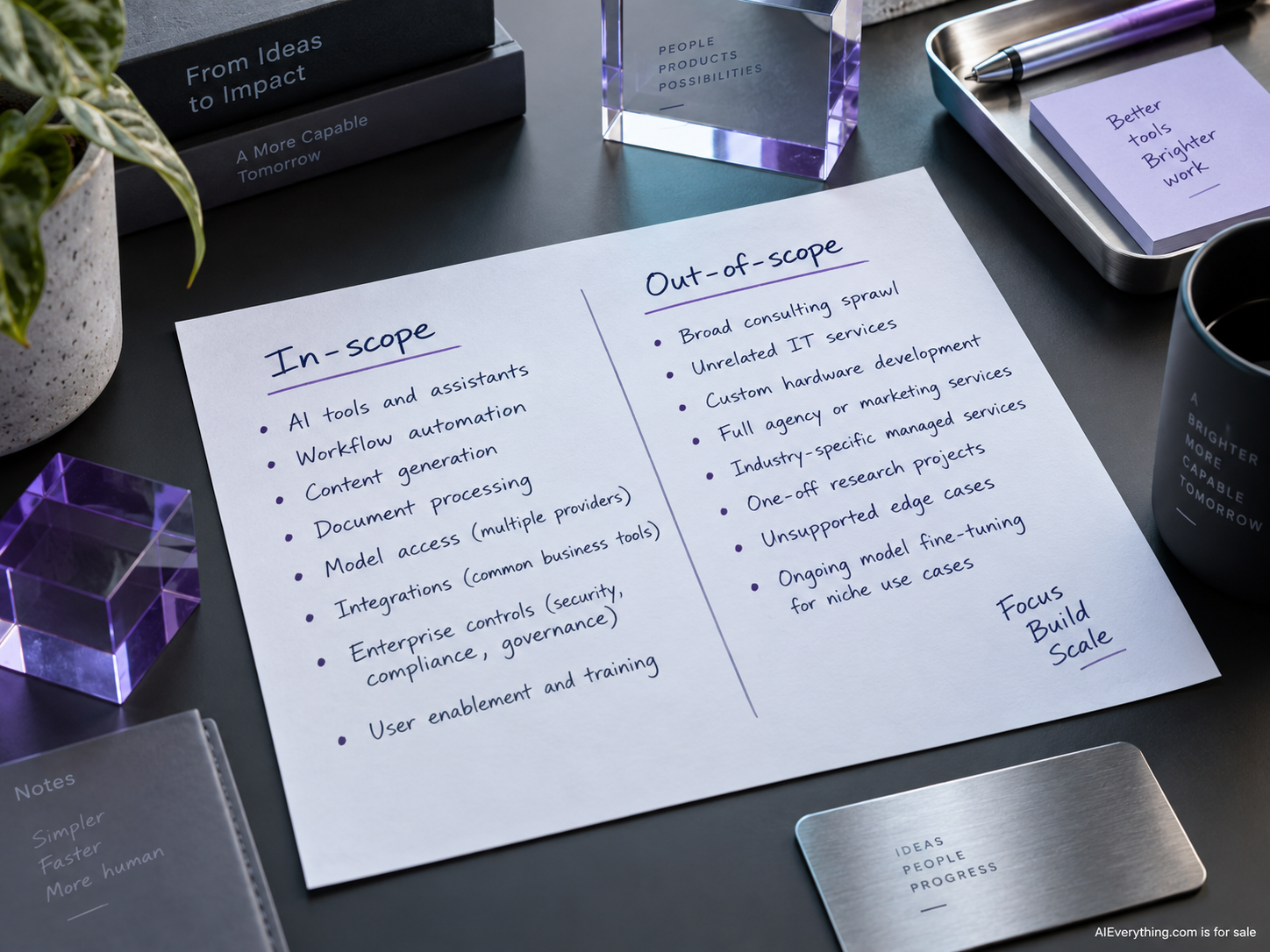
A wide brand does not require a wide first release. An “AI everything” product becomes easier to build and explain when the first version completes one useful job. The ambition can remain broad while the launch scope stays small enough to evaluate. The challenge is deciding which boundaries protect the customer experience and which merely postpone necessary work.
This guide is for a team moving from a collection of possible AI features to a first product brief. The goal is a scope sheet with three included jobs, three excluded jobs, an acceptance plan and an owner for the result. The worked example is illustrative: a workspace that helps a small team prepare internal project updates from approved notes.
Choose a completed job, not a feature category
“Summarization” describes a capability. “Prepare a weekly project update that a manager can review and send” describes a completed job. The latter gives the team a beginning, an end and a person who can judge usefulness. It also includes the ordinary steps that a capability demo may omit, such as choosing sources, editing the output and saving the final version.
Write down the trigger. In the example, the team needs an update before a recurring project meeting. Identify the person gathering information and the person approving the result. Note how the work happens today. If the team already has a dependable template, the product may need to fit that template rather than invent a new format.
Then list the inputs actually available at that moment. Approved notes are different from live access to every project conversation. If the first version requires a person to gather the notes, say so. The product brief should describe the workflow the team can deliver, including any manual preparation, instead of quietly assuming future integrations.
Draw the first boundary in plain language
For the project-update example, the included jobs might be organizing submitted notes, drafting a summary and exporting a reviewed update. The excluded jobs might be deciding project priorities, sending messages without approval and searching private systems that have not been connected. Those boundaries protect the meaning of the product as well as the development schedule.
Use a table that can be understood by support and marketing. A boundary described only in engineering terms may be lost when the product reaches customers. The same distinction should appear in the interface, demonstration and help page. If the product cannot send an update, a button labeled “Publish” would create an expectation the scope deliberately excluded.
| Included in the example | Outside the first release |
|---|---|
| Organize submitted project notes | Search every company system |
| Prepare a draft for review | Choose business priorities |
| Export an approved update | Send updates without a person |
Keep a separate list of attractive later ideas. It gives the team somewhere to put suggestions without turning each discussion into a launch commitment. Add the customer evidence that would justify revisiting each idea. “Several pilot users cannot finish because of this missing step” is more useful than “competitors have it.”
Define acceptance before polishing the interface
Choose examples that represent ordinary work, including incomplete and conflicting notes. For each example, describe what an acceptable result looks like. The product might need to preserve dates, identify an unresolved disagreement and avoid presenting an uncertain statement as settled. A person should be able to inspect the output against those conditions.
Keep a stable set of test examples so changes can be compared over time. Add new examples when a real problem appears, after removing information that should not be retained. A single impressive demonstration is weak evidence for a workflow that will receive varied inputs. Evaluation should reflect the specific job rather than a generic impression that the writing looks fluent.
The NIST AI framework core distinguishes mapping, measuring and managing risks alongside governance. It is a useful reference for assigning the work around evaluation. The team still has to choose tests and decisions appropriate to its product; the framework does not supply a ready-made passing score.
Include the moments when things go wrong
A minimum useful product needs a response to missing inputs, unsuccessful requests and unsuitable material. In the example, empty notes should produce a helpful explanation rather than a confident-looking update. Conflicting dates should remain visible for review. If the service is temporarily unavailable, the person should retain the notes they entered.
These behaviors belong in the first release because they determine whether a customer can recover. They are easy to overlook when scope is reduced by counting screens. A smaller product with a dependable recovery path may be more useful than a larger one that loses work. Ask support what a user would need to explain after each failure.
Decide when the product should ask for human judgment. A project summary can point out that two notes disagree without deciding which team member is right. Make the review step specific: check dates, commitments and missing context. A generic reminder to “verify everything” offers less help than showing the exact places where attention is needed.
Budget for the whole task
Estimate the work from input to completed output, including the parts outside the generation step. Someone must manage accounts, answer questions, maintain examples and respond when an underlying service changes. The first release also needs a way to remove information according to the product’s stated policy. These responsibilities should have owners before a pilot starts.
For cost planning, separate fixed work from usage-sensitive work. Design and documentation do not behave like a service charged per request. Use observed pilot behavior to revise assumptions once it exists, and label early estimates as estimates. Avoid presenting a hypothetical saving as a measured customer outcome.
Latency belongs in the workflow plan too. A user waiting for a short update needs a clear progress state and a way to recover if the request fails. The team should decide what happens when the task takes longer than expected. Promising an instant result in marketing would create an unnecessary conflict with that operational reality.
Run a pilot that can change the plan
Choose a small set of people who regularly perform the target job. Give them an ordinary task, not a polished demonstration script. Ask what they expected, where they stopped and what they changed before using the result. Treat their behavior as information about the workflow rather than as a verdict on every possible future product.
Agree on a review point and a decision owner. The pilot may support continuing, narrowing the audience or changing the job. It should also be allowed to stop. A broad domain can accommodate a revised direction without making every earlier feature part of a permanent promise.
Before expanding, check whether users can finish the original task repeatedly. If they still need help with the same handoff, fix that handoff before adding a new capability. The AI product suite concept explores how related products could grow from a shared foundation once the first workflow is dependable.
Finish the scope sheet with three included jobs and three explicit exclusions. Put a real owner beside acceptance, support and the next review. That page should be short enough to bring to a planning meeting and concrete enough to settle a disagreement. The brand can describe the larger direction; the release should make a smaller promise and keep it.