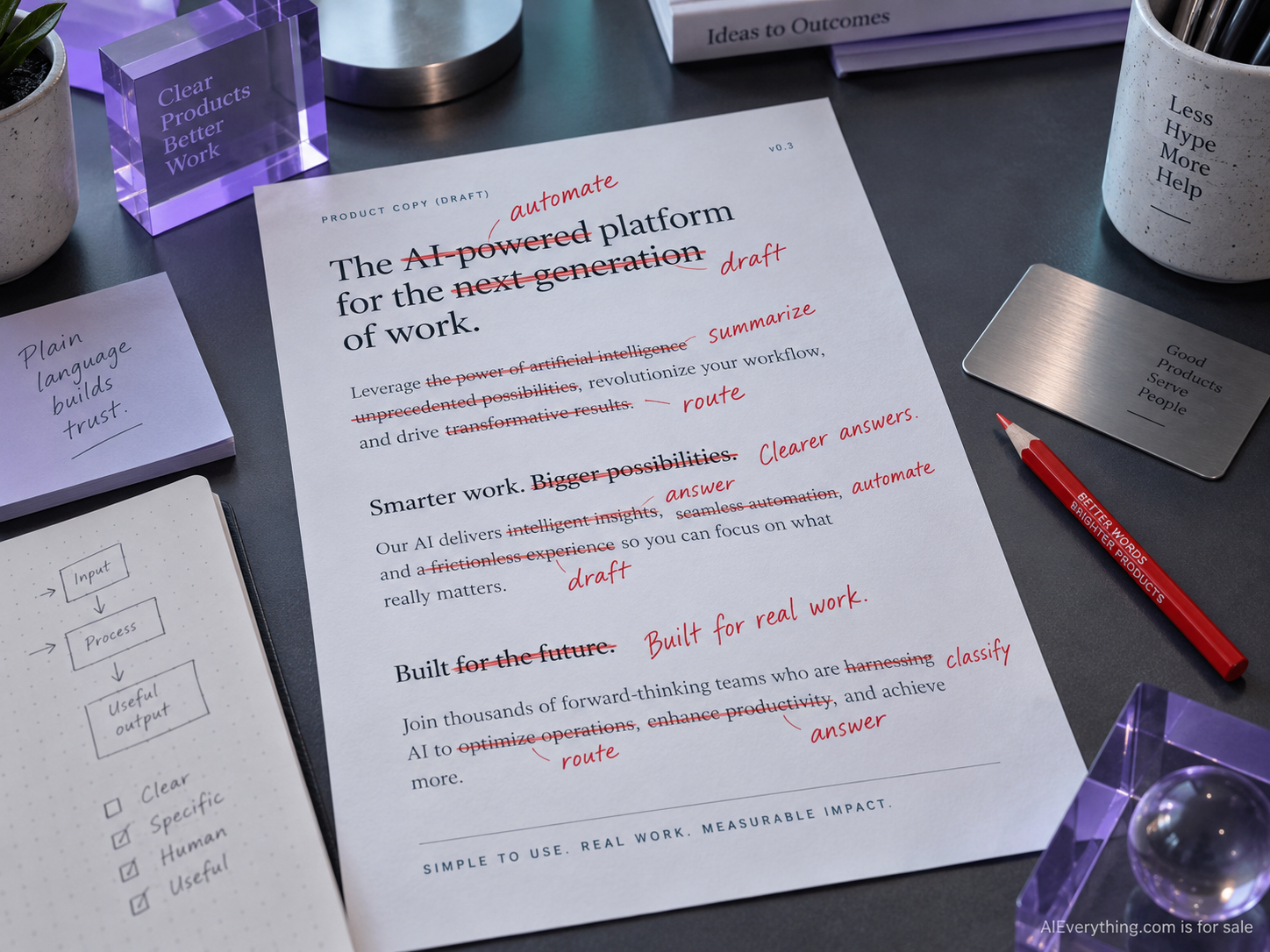
AI-washing begins when a product description uses the category to suggest more capability than the product can demonstrate. Sometimes the problem is an inflated claim. Sometimes it is a vague sentence that leaves the buyer to imagine the useful part. Clear copy gives the reader an action, an input, an output and enough context to judge the offer.
This guide is an editing exercise for founders and marketers. It is not a compliance audit. The aim is to revise one product paragraph so that a reader can understand the actual workflow and the evidence behind any performance claim. The examples are invented for illustration and do not describe features currently available at AIEverything.com.
Underline every claim in the paragraph
Take the main paragraph from a product page and mark every statement about what the product does. Include claims hidden inside adjectives. “Effortless,” “accurate,” “secure” and “autonomous” can all shape the buyer’s expectations. A sentence does not become harmless because it sounds like branding rather than a specification.
Next to each marked phrase, write what a customer could reasonably expect from it. “Handles customer support” might be read as receiving a question, finding an answer, sending it and following up. If the product only drafts a suggested reply, the original phrase describes a much larger job. The editing task is to bring the sentence back to the behavior the product actually delivers.
Separate three categories: observable behavior, measured results and future plans. Observable behavior can be demonstrated in the current version. Measured results need a documented basis and context. Future plans belong in clearly identified planning language. Keeping those categories apart prevents a roadmap item from becoming a present-tense promise during a rewrite.
Replace the label with the action
Consider this illustrative sentence: “Our intelligent platform transforms your knowledge into effortless productivity.” It offers no input, no output and no decision the reader can make. The words sound positive, but the customer still does not know what happens after signing in. Adding another adjective will not fix the missing information.
A more useful version might be: “Upload approved project notes to prepare a draft update, with links back to the notes for review.” This tells the reader what to supply, what to expect and what review involves. It still needs to be checked against the actual product. If links are not provided, that phrase should be removed rather than treated as aspirational wording.
Use verbs close to the interface: draft, group, compare, extract, suggest or export. Choose the verb that accurately describes the action. “Decide” is different from “suggest,” and “send” is different from “prepare.” Those distinctions help buyers understand their own responsibilities and give support a clearer starting point when questions arise.
Put evidence beside the result
If a paragraph makes a performance claim, identify the evidence before deciding how to phrase it. Record the task, test conditions, comparison and limits. A result measured on one narrow exercise should not become a claim about every customer’s work. The words around a number are part of the claim, not optional fine print.
The FTC’s advertising and marketing guidance says that claims must be truthful and evidence-based. For an editor, that creates a practical check: can the person responsible for the product explain why the statement is supportable? If the answer is only that the phrase appears on other websites, it needs revision.
When no measured result exists, describe the behavior without inventing a saving. “Groups similar questions for review” may be a useful claim if it is demonstrable. “Cuts support work in half” requires a different level of evidence. An early product can be interesting because it solves a recognizable task, even before the operator has outcome data worth publishing.
Explain the human step specifically
“Human in the loop” is often too abstract to help a buyer. Name the person’s action. Does a reviewer check the source, approve a message, choose among suggestions or correct a classification? Put that step in the main description if it is central to using the product successfully.
For the project-update example, a useful instruction could be: “Review dates and commitments before sharing the draft.” A better interface might highlight the source passages that support those details. The copy should match the assistance the product provides. It should not imply that a generic approval button makes an output reliable.
Also explain what happens when the system cannot help. A tool might ask for more information, leave a field blank or decline a request. Those behaviors can be described positively and plainly. The customer needs to know how to recover, especially when the product is being used as part of a recurring business process.
Review trust language with the right owner
Security, privacy and access statements need careful ownership. A marketer should not infer them from a polished interface or the reputation of an underlying provider. Ask the person responsible for the system to confirm the actual behavior and the limits of the statement. Link to the relevant details where they help the buyer make a decision.
A vendor integration should be described as an integration. It should not quietly become a partnership or endorsement. Likewise, using a model to assist a workflow does not mean the product performs every capability associated with that model. Keep the explanation at the level of the product the customer is evaluating.
The NIST AI Risk Management Framework offers a reference for considering AI-related responsibilities. Citing it can support a discussion about risk management, but it does not prove that a product meets a security standard. The editor should resist turning a useful reference into a decorative trust badge.
Check screenshots, buttons and short labels
A precise paragraph can still be undermined by a misleading screenshot caption. Audit the small text around the product as well as the headline. A button labeled “Auto-resolve” creates a different expectation from “Draft reply.” If the next screen asks a person to finish the work, the first label should prepare them for that step.
Look at examples as a buyer would. Are the inputs plausible? Is the output edited without disclosure? Does the demonstration skip a required step? A sample can be simplified to teach the workflow, but the simplification should not create a false impression of what happens in ordinary use. Mark illustrative examples and keep them consistent with the current product.
Review copy in the channels where it is shortened. An accurate sentence can lose its qualification when reused in an advertisement, social post or sales slide. Keep a small set of approved descriptions with the necessary context attached. This is especially useful when several people explain the same product to different audiences.
Run a five-question edit
- Who is the product for in this paragraph?
- What information or action starts the workflow?
- What does the product actually produce?
- What does a person still need to check or decide?
- Which claims require evidence, and where is that evidence?
Read the revised paragraph to someone unfamiliar with the product and ask what they expect to happen. Their answer will reveal whether the important distinctions survived the edit. Do not ask only whether the copy sounds good. A pleasing sentence that creates the wrong expectation still needs work.
Save the before-and-after version with the reason for each change. Revisit the paragraph when the product changes, rather than adding new capability words to an old promise. For a broad identity such as AIEverything.com, this discipline is particularly useful: the name can open the conversation, while the copy tells the buyer exactly where the offer begins.