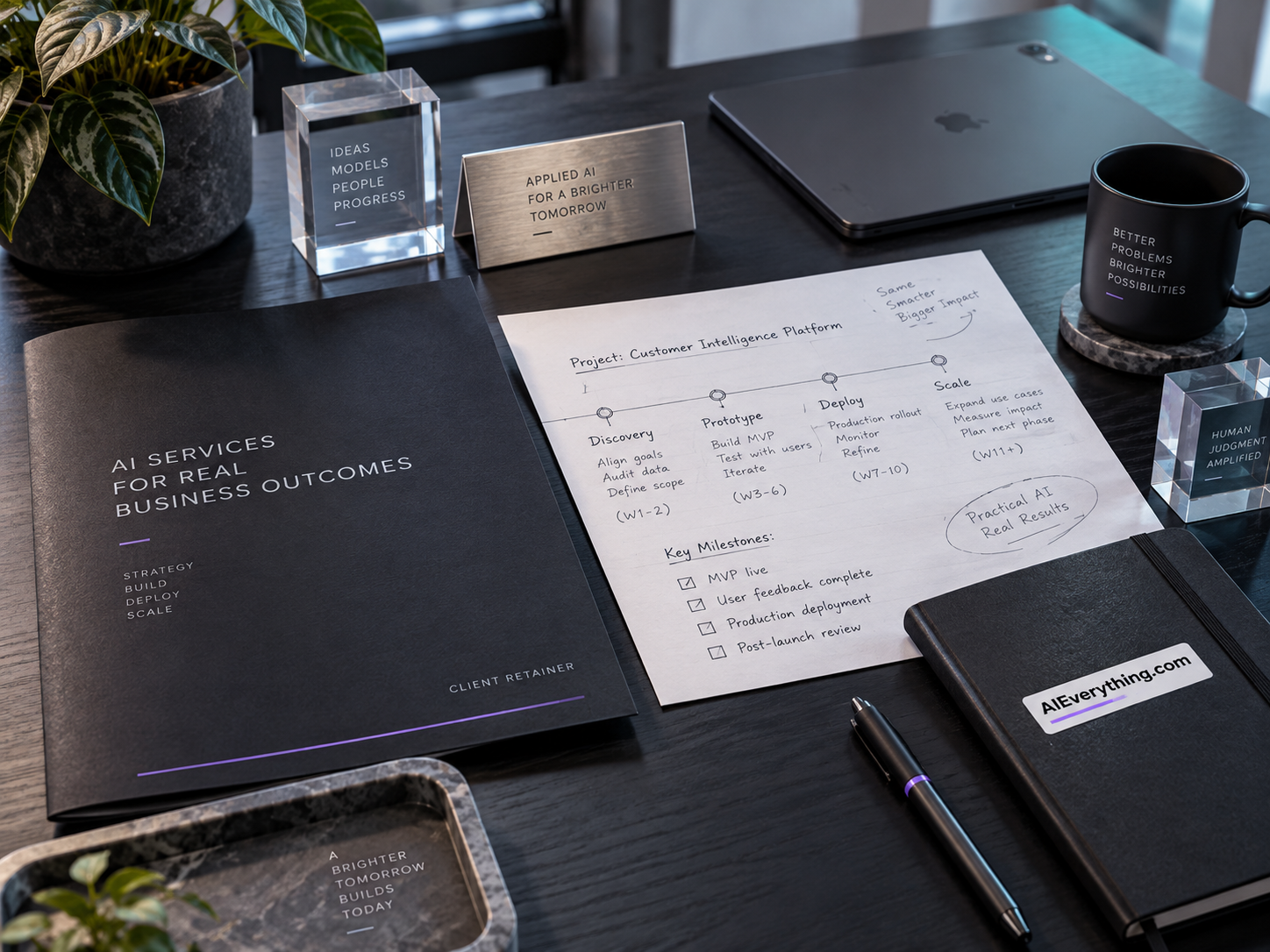
An AI consulting business could use AIEverything.com as a clear category address while keeping each engagement specific. The buyer would understand the broad field before reading the offer. The firm would then need to explain the work it actually delivers: discovery, a bounded implementation, staff training or ongoing maintenance. A broad brand works best when the commercial offer is easy to describe.
This is an illustrative agency concept, not an existing service offered with the domain. The likely customer is an operator who has identified a repetitive process but cannot yet tell whether AI is the right tool. That person may have a budget and an internal sponsor, yet still need help defining a project that can be accepted, maintained and handed over.
Sell a decision before an implementation
The first offer could be a workflow assessment with a defined deliverable. The consultant would document the present process, identify where people spend time, inspect the available information and recommend a next step. A useful assessment might conclude that a rules-based change is sufficient. That conclusion should still count as successful work if it saves the customer from commissioning an unsuitable system.
For an illustrative example, imagine a distributor receiving product questions through a shared inbox. A proposed assessment could map how staff locate answers, which questions need a specialist and what information changes frequently. The deliverable would be a workflow map and a proposed pilot, with a separate list of unanswered questions. It would not promise autonomous handling of every message.
This gives the sales conversation a practical shape. The firm can ask for a process owner and sample materials before discussing the build. It can also explain what the customer must supply and what happens when the necessary records are missing. Scope becomes a shared document instead of an optimistic paragraph in a proposal.
Structure the work around acceptance
A second engagement could implement one approved slice of the workflow. In the distributor example, that might be drafting replies for a person to check. The project should specify what counts as an acceptable draft, what sources it can use and when it must decline to suggest an answer. The customer needs to agree on those conditions before development begins.
A handover package could include operating instructions, known limitations, test examples and a named maintenance owner. These are proposed deliverables, not claims about a current agency. They matter because the work continues after the demonstration. Product information changes, access rights change and staff members need a way to report mistakes without guessing which supplier to contact.
For a starting vocabulary on responsibilities, the NIST framework core organizes AI risk management around Govern, Map, Measure and Manage. A consulting team could use those functions to structure questions. Mentioning the framework should never imply that a project has received an official seal of approval.
Choose the first buyer carefully
Pick a buyer who can authorize the first engagement. The firm can add other practices as its delivery team grows. An operations leader at a distributor has different constraints from a marketing director at a retailer. The firm should choose one audience whose work it understands and write a service page around the decisions that person can authorize.
That page should describe a trigger, a deliverable and a stopping point. “When product questions overwhelm the shared inbox, assess a reviewed reply workflow” gives a reader something concrete to discuss. “Transform every part of the business with AI” leaves the buyer to invent the project. The domain can carry the category; the offer must carry the detail.
Specialist partners may be useful when the project touches data protection, security or an industry-specific requirement. Their responsibilities should be agreed in the proposal. The firm should only publish credentials, vendor relationships and customer results that can be verified and shared with permission. An early business can explain its method without pretending to have a long list of completed engagements.
Find demand through a useful workshop
A plausible distribution route is a small workshop for one professional community. The session could teach attendees to map a repetitive workflow and identify which decisions still need human judgment. Participants would leave with a usable worksheet. The consulting offer would be the option to develop the map into an assessment, rather than a surprise sales pitch.
The workshop would also reveal language for the service page. Listen for the names attendees give to queues, approvals and exceptions. Their description of a “reply waiting on technical” may be more useful than a polished phrase about knowledge automation. Record recurring questions and answer them in public articles, while keeping company details private.
Publish a sample deliverable using invented business data, clearly labeled as an example. It can show the level of detail a client would receive without fabricating a case study. Include an unresolved issue in the sample so readers understand that an assessment is a decision tool, not a guarantee that every proposed use should go ahead.
Keep the commercial model understandable
The business could offer separately scoped assessments, implementation projects and maintenance agreements. Any retainer described at the planning stage should be treated as illustrative. The terms would need to state what support includes, what triggers a new project and who pays for underlying services. Customers should be able to distinguish consulting work from software charges.
Compare this direction with the product suite concept. An agency depends on people delivering and supporting engagements; a product business depends on repeatable software behavior. AIEverything.com could fit either, but the team, economics and launch plan would differ. Choosing between them early would make the naming decision more useful.
An acquisition inquiry can briefly describe the proposed practice and target customer. For a partnership, include the operator’s experience, available delivery team and first distribution route. The domain can give the firm a direct starting identity; the quality of its work will determine what that identity comes to mean.